| Home |
|
|||||
 | ||||||
Jedi Counseling 111Atonement Ain't Easy | ||||||
|
Welcome to the 111th installment of "Jedi Counseling," our regular column in which we answer your rules questions about the Star Wars Miniatures Game and the Star Wars Roleplaying Game. If you have a question, send it in through the link at the end of this column, and check back here for the official answer. Star Wars Roleplaying Game Saga Edition
Q: Atonement seems too easy. It's common to have Force Points left over upon gaining a level. Since they would be lost anyway, couldn't you spend them on atonement, effectively reducing your Dark Side Score for no real cost? A: Atonement isn't quite that simple. It requires "a period of meditation, reflection, and absolution" on the part of the character, so it isn't a quick or instantaneous process. First, the player declares that his character is attempting to atone, spending 1 Force Point as a swift action; this represents the character pausing as she realizes that she is walking down the wrong path. Next, the Gamemaster decides how to adjudicate the attempt to atone, such as how long it will take, whether any special acts of contrition will be required, and so forth. If performed "on stage," it should span at least the length of an adventure (during which the hero is essentially a total saint). If performed between adventures, it will normally require at least a week and possibly as long as months (even years!) of sincere reflection. The precise time and effort required should usually reflect the character's transgressions, so someone with a very high Dark Side Score may have to meet a higher standard to prove that the atonement is sincere. The GM also adjudicates when the attempt is successful. If the hero's actions don't reflect a sincere desire to atone, her Dark Side Score won't be reduced. Still, the details are up to the GM, and atonement should never interfere with the needs of the campaign. One last detail here: You can atone only 1 point at a time. This means that you can't spend all your leftover Force Points just before you gain a level. You could start a period of atonement, certainly, but it wouldn't end for quite some time (as described above). Q: If you have Force Point Recovery and you atone to reduce your Dark Side Score, do you get the Force Point back? A: No. Force Points that you sacrifice for atonement are permanently lost and cannot be recovered by any means. Q: I'm having some problems deciding what type of transgression some actions should be. How can you tell when something is blatantly evil (a major transgression), questionably evil (a moderate transgression), or dubiously evil (a minor transgression)? A: While the precise divisions are ultimately up to the GM, enforcing them as loosely or tightly as appropriate for the campaign, here are some guidelines to help you decide on corner cases. To decide if an action is "blatantly evil," ask yourself the following questions:
If the answer to all of these questions is "Yes," then the action is almost certainly "blatantly evil" (a major transgression) and deserves increasing the character's Dark Side Score. Examples include murder, torture (including acts such as intentional mutilation or maiming), slavery, rape, and any similar act considered reprehensible by most civilizations. If exactly one question can be answered "No," then the action is probably "questionably evil" (a moderate transgression), which might be worth increasing the character's Dark Side Score. Examples include assassinating an Imperial warlord who is about to give orders to exterminate the population of a planet (it's in defense of others, but he's still at your mercy), tormenting a droid to extract information, or starting an unnecessary fight that results in serious injury. If exactly two of the questions can be answered "No," then the action is probably "dubiously evil" (a minor transgression) and likely doesn't deserve increasing the character's Dark Side Score. Examples include killing in self-defense or recklessly (but accidentally) causing injury to others. If three or more questions can be answered "No," then the action probably is not a dark side transgression at all. For example, destroying an object is not a transgression unless doing so also causes some sort of substantial harm to a character. Similarly, hunting an animal (not sentient) in the wilderness (not helpless) for sustenance (protecting yourself from starvation) is perfectly acceptable in all but the most unusual circumstances. Obviously, you'll still need to interpret the situation accordingly. How strictly do you want to define "harm"? For example, is a rich character harmed in a significant way by having a minor treasure stolen? Is a threat imminent and real, or is the character merely trying to justify unnecessary aggression? The purpose of these questions isn't to give you a never-fail method but to help you evaluate an action. When in doubt, go with your gut instinct. The more you have to parse and explain an action to make it acceptable, the more likely it is to be a transgression. Q: Would Severing Strike be a major transgression? It seems that you'd never learn this talent unless you intended to maim others. A: No, Severing Strike, in itself, is not a transgression because it is designed to protect your target from an otherwise lethal blow. The same would be true for a doctor who has to perform a medical amputation. Although the act is "maiming" in the strictest sense, it is only to protect the target from a more dangerous medical problem.
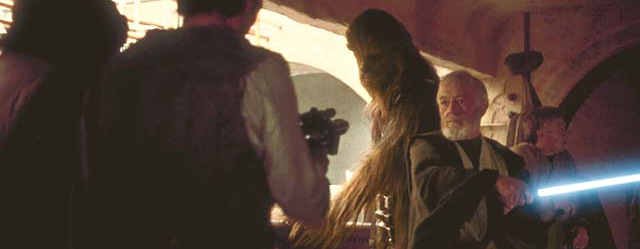
This doesn't mean that Severing Strike can't be used in a blatantly evil way, of course. Cutting off the limbs of an enemy who is at your mercy would still be tantamount to torture no matter how you do it (by lightsaber, scalpel, or angry Wookiee). Q: What happens if you use move object against a door? How about Force thrust? A: If you use move object against a door, you deal normal damage to it as the door strains against its frame. (Don't forget to apply the effects of the door's damage reduction.) If the damage is sufficient to reduce the door to 0 hit points, it becomes disabled and the door is pulled free, making the doorway passable. If you use Force thrust against a door, compare your Use the Force check result to the door's break DC. If successful, you have forced the door open. If not, the door remains intact and functional. For those who are interested, an object's break DC is calculated as if it were a character resisting a bantha rush or Force thrust. Take its Strength bonus, add 10 (the average result on a roll of 1d20, rounded down), and -- in most cases -- add 5 more for being exceptionally stable. (Some particularly fragile objects may deviate on this last detail, but that is fairly rare.) Star Wars Miniatures QuestionsQ: I have some questions about Force Push. When an enemy is pushed, the acting character gets to decide which way to push the affected character (according to the rules insert in The Force Unleashed). Does that mean I can move the character around obstacles or other characters to get it farther away? A: Each square of push must enter a square that is farther away from the acting character than the character's currently occupied space. Furthermore, you must move the affected character if such a space is available and if you have enough push squares remaining to move the character into that space. Beyond these limitations, the acting character's controller can choose which square the character is pushed into, avoiding obstacles and other characters as desired. Q: What is the order of resolution for Force Push? Do you deal damage first, push the character first, or can you choose?
A: First, resolve all effects of the damage to a specific character (acting character's choice). If the character is defeated, resolve all effects that come into play at that time (such as Self Destruct, Impulsive Shot, and so forth). If the character is not defeated, resolve the push effect (and stun effect, if applicable) for that particular character. Once the effect is completely resolved for one character, move on to the next affected character (if applicable), again chosen by the acting character. Q: Can a character be pushed into a pit? A: Yes, assuming that the pit square meets the requirements listed earlier (it must be farther away from the acting character than the affected character's currently occupied square). The errata has been updated to handle this situation, but it's worth repeating here: "If a character is involuntarily moved onto a pit square, stop its movement in the nearest square adjacent to the pit and make a save of 11. On a successful save, the character remains adjacent to the pit. On a failure, it is defeated. Characters with abilities that allow them to enter pit squares (such Flight) make a save of 6 instead." Q: What happens if a character uses Force Push 3 or 5 on an adjacent enemy? Does the character push itself? A: No. The acting character takes the damage and stunning effects because it is adjacent to the target enemy. However, it is not possible to move a character such that it is farther away from itself; there is no legal square that the acting character can be pushed into. As such, the acting character does not push itself. Q: Let's say a character with Force Push 3 or 5 is a passenger on a transporting character (such as something with the Desert Skiff or Troop Cart special abilities). If the transporting character is adjacent to the targeted enemy, is the transported character pushed? A: No, for the reasons listed above. Since the acting character is a passenger, it automatically moves with the transporting character. Given this, there is no square into which you can push the transporting character that would increase its range from the acting character, so the transporting character stays in its current space.
About the AuthorGary M. Sarli is a freelance designer, developer, and editor whose credits include the Saga Edition rulebook, Starships of the Galaxy, and the Dawn of Defiance adventure path. When not making games, he moderates on the Gleemax forums as WizO the Hutt (cheerfully feeding Code of Conduct violators to the Sarlacc) and operates his store, GMSarli Games (an online shop specializing in nonrandom miniatures packs designed for the Star Wars Roleplaying Game and Dungeons & Dragons). | ||||||