

| Home |
|
||||
 | |||||
Saga Edition Preview 6Droids, Droids, Droids | |||||
Of course, heroic droids present several roleplaying challenges. The Star Wars universe treats droids as property, sometimes for comedic value, and sometimes such that droids become more like background elements than story motivators. Droid TraitsAs in previous editions of the game, all droids share common traits that define how they differ from living characters. Droid traits are similar to species traits, an intentional design choice that makes it easier to envision a droid hero. In essence, "droid" becomes the character's species, just as "Mon Calamari" or "Zabrak" are species choices. All droids share the following droid traits. Abilities: Droids are nonliving entities, so they don't have Constitution scores. Droids can increase any two of their five remaining ability scores by +1 each at 4th level and every four levels thereafter, just like any other character. These increases represent improved heuristics and algorithms that the droid has developed from experience, as well as upgrades to its components as part of routine maintenance. Droid ability modifiers are determined by their degree and size. A droid can never have an ability score less than 1, regardless of modifications. Automatic Languages: Droids know Binary plus one language chosen by the designer (usually Basic). Behavioral Inhibitors: Droids (except 4th-degree droids) cannot intentionally harm a sentient living being or knowingly allow a sentient living being to be harmed. Droids must follow orders given to them by their rightful owners, as long as those orders don't require the droid to harm a sentient living being. Droids with heuristic processors can sometimes violate these restrictions by creatively interpreting their behavioral inhibitions.
Ion Damage Vulnerability: As electronic constructs, droids are vulnerable to damage from ion weapons. Generally, ion weapons have the same effect on droids that stun weapons have on living beings. Maintenance: Droids don't sleep, eat, or breathe. However, after 100 hours of operation, they must enter shutdown mode and recharge for 1 hour. If a droid fails to do so, it must make a successful Endurance check each hour (DC 10, +1 per each hour after the first) or move –1 persistent step along the condition track. This persistent condition can be removed only if the droid recharges for 1 hour. Memory: A droid's trained skills, feats, and talents can be reassigned with the Use Computer skill. A droid hero can use its own Use Computer skill to carry out this reprogramming, but it takes a –5 penalty on its skill check. If a droid is ever subjected to a complete memory wipe, it becomes a basic model of its type, losing any levels and abilities gained. Nonliving: A droid is immune to poison, disease, radiation, noncorrosive atmospheric hazards, vacuum, mind-affecting effects, stunning effects, and any other effect that works only on living targets. Droids have no connection to the Force and can't gain the Force Sensitivity feat or learn Force powers. Since droids have no Constitution score, they don't get bonus hit points for having a high Constitution, and they apply their Strength modifier to their Fortitude Defense. Unlike living beings, droids don't "die," but they can be disabled or destroyed. Disabled: If a droid is reduced to 0 hit points, it becomes disabled and can't be reactivated until it is repaired so that it has at least 1 hit point. Destroyed: If the attack that reduced the droid to 0 hit points also exceeds the droid's damage threshold, the droid is destroyed instead. A destroyed droid cannot be repaired or salvaged. Repair: Droids can regain lost hit points only through the use of the Mechanics skill. A droid can use this skill to repair itself, but it takes a –5 penalty on its skill check. Shut Down: A droid that is shut down can take no actions and is effectively unconscious. Shutting down a willing droid is a standard action. To shut down an unwilling droid, you must grab the droid and make a successful Mechanics check (DC equal to the droid's Will Defense) as a standard action while it's grabbed. You cannot shut down an unwilling droid with locked access unless it is disabled or otherwise helpless. Skills: Droids normally cannot use any skill untrained except for Acrobatics, Climb, Jump, and Perception. A droid with a heuristic processor ignores this limitation. Systems: Installing or replacing a droid's systems can change many of its characteristics. Playing an Existing ModelPlayers who want to run heroic droids might wish to choose an iconic droid type. The droid chapter of the Saga Edition rulebook presents R2 units, 3PO series protocol droids, and a number of other standard droid types. Though not all droids in the book are suitable for heroic play, a great many of them are.
In terms of game mechanics, this option is very similar to the rules in previous editions. The specific droid model you choose determines your ability scores, size, class, and level. If you choose a droid model that has 1 or 2 levels in the nonheroic class, you can add 1 level of a heroic class of your choice. Otherwise, you can play a droid with 3 nonheroic levels or 1 heroic level, and character generation proceeds as normal. Playing a New ModelIn Saga Edition, you can also create a new custom droid model, choosing its ability scores, class levels, skills, feats, talents, and gear. This option allows you to set the droid model's ability scores, select its "degree" (a designation based on its role), and give it weapons and equipment that define the equivalent of a new stock model of that droid. For example, let's say you want to play a combat-oriented droid. You could make use of the statistics for the B1 Series or B2 Series battle droid, but that might not fit your vision. Instead, you can create a new droid model, assign ability scores that are geared more closely to your desired role (in this case, you'd probably give the droid high Strength and Dexterity scores), pick a standard class (such as soldier), and continue with character generation as normal. The end result -- the 1st-level character that you create -- becomes a new stock model of droid, and your particular character becomes a heroic individual droid that has a role to play in galactic events. Tinkering With Your DroidThe Saga Edition rules make it simpler and more logical to tinker with droids. To modify a droid's hardware, characters (including droids themselves) use the Mechanics skill. To reprogram a droid's software, they turn to the Use Computer skill. In keeping with the goal of making droids more suitable for heroic use, reprogramming a droid requires a character to overcome the droid's Will Defense -- a sign that you have penetrated the droid's software defenses. This ensures that heroic droids are more resistant to reprogramming than stock models. Sample Droid: Droideka
The main propulsion method is a microrepulsor-assisted wheel mode that allows a destroyer droid to fold itself into a roughly wheel-shaped package and roll along at high speeds. Though lightning-swift in this mode, the droid is considerably more ponderous when unfolded for combat. A destroyer droid has two heavy repeating blasters that can lay down a devastating barrage. To augment its bronzium armor shell, the droid also comes equipped with a deflector shield generator. The tremendous energy drain of the blasters and shields necessitates that the destroyer droid be equipped with a mini-reactor. Destroyer droids can't be played as droid heroes.
Next TimeNow that you've seen previews of character creation and combat, let's see how they all work together by breaking down a scene from Return of the Jedi -- the skirmish at the Great Pit of Carkoon! | |||||


 When we revamped the rules for droids for the Star Wars Roleplaying Game Saga Edition, one of our primary goals was to make it easier to play heroic droid characters. Just as C-3PO and R2-D2 are present throughout the Star Wars saga, players should have the option of bringing their own interesting droids into the campaign's story.
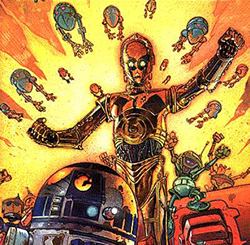 The Force: One major change to the droid rules is that droids can now gain Force Points and take advantage of the new Destiny mechanic. Though droids can't become Force Sensitive, they make use of Force Points in the same way that other characters do. This change encourages droid heroes to take the same chances -- and attempt the same heroic actions -- as the droid duo from the Star Wars films.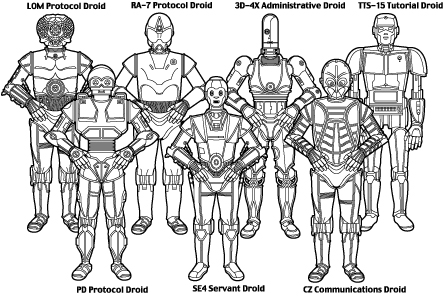
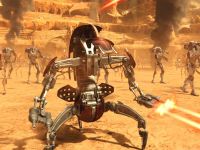 Designed and built by the Geonosians and the Collicoids of Colla IV, the Droideka Series destroyer droids reflect the savage ferocity of their makers.