| Home |
|
|||
 | ||||
Jedi Counseling 106 | ||||
 Welcome to the 106th installment of "Jedi Counseling," our regular column in which we answer your rules questions about the Star Wars Miniatures Game and the Star Wars Roleplaying Game. If you have a question, send it in through the link at the end of this column, and check back here for the official answer. Star Wars Roleplaying Game Saga EditionQ: The Jedi class table includes "Build Lightsaber" at 7th level. Does this mean that only a Jedi can build a lightsaber? A: No. As noted in the "Building a Lightsaber" sidebar (Saga Edition Core Rulebook, page 40), a lightsaber can be built by any character who has at least seven heroic levels, has the Force Sensitivity feat, and is proficient with lightsabers. The entry in the Jedi class is just meant to be a reminder of this fact. Q: Why are Block, Deflect, and Redirect three separate talents? All Jedi -- even the younglings that Yoda trained -- seem to be capable of this basic ability, so why isn't it a single talent (or even a built-in class feature) that you get at 1st level?
A: First, there's a difference between cinematically using a lightsaber to deflect a shot or block an incoming blow, and mechanically gaining a specific benefit from deflecting or blocking an attack. All characters, Jedi or otherwise, avoid attacks however they can -- dodging, ducking, weaving, parrying, blocking, or even deflecting -- and all of these things are built into a character's Reflex Defense. If you're proficient with and wielding a lightsaber, at least some of the attacks that miss you are deflected, parried, or blocked in a cinematic sense. You aren't gaining any mechanical benefit from it, though, because you haven't managed to hone that ability enough to make a difference until you take the Deflect or Block talents. Once you take those talents, you gain the ability to defend yourself even more effectively, making a Use the Force check to nullify an attack that beats your Reflex Defense. As for why these abilities are separated into multiple talents, we decided that the abilities were so useful that they would be a "no-brainer" choice if they were combined into a single talent. In other words, almost every Jedi would take this at 1st level, no matter what. No other choice would be competitive unless you were playing a character who was not combat oriented at all. In addition, making them separate talents also gives each Jedi more individuality.
In the end, abilities like these are extremely useful, and, in our opinion, it's worth spending a talent for any one of them. Certainly, a Jedi might take all three (and many do), but it isn't necessary to take all three for every character concept, and some Jedi may choose to take none at all. Even without the extra mechanical benefits of these talents, you can still describe your Jedi parrying blaster bolts out of the air or locking sabers with a Sith Lord. Game mechanics are meant to enhance the cinematic flair, not restrain it. Q: Why are the lightsaber form talents unique to the Jedi Knight prestige class? Various Sith Lords have been described as masters of a particular form, and not all of them are former Jedi Knights. Therefore, many would be unable to take the talent associated with the form they have mastered (or possibly invented). Is this a mistake?
The form talents are meant to represent unique benefits that Jedi -- with their greater emphasis on meditative and disciplined study, the sublime emptiness of serenity, and patient reflection on the will of the Force -- can gain from devoting themselves to a particular form. Sith, meanwhile, are not as meditative, disciplined, serene, or reflective. Instead, they're about passion, rage, strength, and desire, and their talents (such as Dark Scourge and Wicked Strike) reflect this. In any case, a Jedi Knight and a Sith apprentice of the same level, both devoting themselves to lightsaber combat, can learn the same number of lightsaber- and combat-related talents, but the specific talents may vary. In other words, the Jedi aren't better than the Sith when using a particular form; they're just different. Q: When multiclassing, do you need to have the Force Sensitivity feat to take a level in the Jedi class? A: No. You can take Force Sensitivity as your starting feat (or, if you wish, you can take a different starting feat). Q: Does that mean that you could have a Jedi who is not Force-sensitive? A: In game mechanical terms, yes, a character can have levels in the Jedi class without having the Force Sensitivity feat. Obviously, she can't have any talents, such as Deflect and Block, that require a Use the Force check to function. Furthermore, she can't have any Jedi talents that must be activated by spending a Force Point. Such abilities are meant to reflect her actual connection to the Force, so a character without the Force Sensitivity feat can't use them. To an in-universe observer, though, such a character would never be described as a "Jedi." She would be regarded as someone who has studied some of the Jedi arts, but few would confuse that with being a member of the Jedi Order. As an analogy, consider that someone on Earth who studies kung fu would not automatically be thought of as a Shaolin monk. Remember that the Jedi class isn't only about the Force -- it's broader, encompassing all the Jedi arts. Thus, a non-Force-sensitive duelist might study under a Jedi and take levels in the Jedi class, becoming more skillful with a lightsaber despite having no ability to use the Force (and thus no access to some of the class's best talents, such as Deflect and Block). In fact, a character like General Grievous fits this profile very well, and it would be perfectly valid to create his character with levels in Jedi to reflect his years of study under Count Dooku.
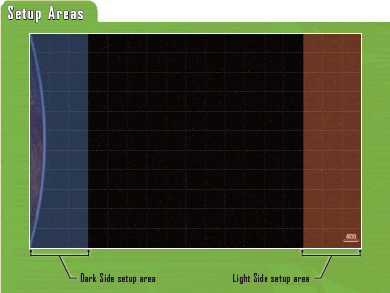
Finally -- to borrow from the Shaolin analogy -- a martial artist might take levels in Jedi to pick up some Jedi Guardian talents, such as Acrobatic Recovery or Elusive Target, as part of his studies. In none of these cases, though, would such a character be considered an actual "Jedi" to an in-universe observer. Nevertheless, remember that the rules on multiclassing specifically require that the Gamemaster approve of any multiclassing choice. Before you take levels in the Jedi class, the GM might require that you find a Jedi to teach you or that you have the Force Sensitivity feat (or both, or neither, or any other restriction that seems appropriate). There's absolutely nothing wrong with adding such a restriction if it fits the tone of the GM's campaign. Q: The rules for droids say that you can't select Jedi as your class at 1st level. Given the ruling above, could a droid multiclass and take levels in Jedi after 1st level? A: Yes. In fact, in Shadows of the Empire, Darth Vader had some customized ASP labor droids that were modified to serve as lightsaber-sparring partners. Such droids could be represented in the game by having at least some levels in the Jedi class to pick up lightsaber combat talents. Star Wars Miniatures QuestionsLet's address some questions that have come up about the Starship Battles game. Q: The rulebook states that you're supposed to put your fleet in the setup area. What happens if you can't fit all your ships in that area? A: Your goal is to set up your fleet using the absolute minimum number of squares outside the setup area, using the following procedure:
You can't intentionally space ships out so that you can fit fewer of them in the setup area. For example, you can't leave 1-square-wide gaps between Class 2 ships (each gap too small for another Class 2 ship) to force some of your ships to be outside the setup area. If your opponent describes a method to arrange your ships that uses up less area outside the setup area, you must rearrange your fleet until you can take up as little space as he or she described. Of course, none of this applies if you can fit your entire fleet inside the setup area. Q: Can a ship that moves diagonally end its movement facing diagonally (in other words, with its front facing a corner)? A: No. There are only four facings available, and the front of the ship must always face the side of a square, not the corner. Q:Can Class 1 or Class 2 ships turn without moving (in other words, turn in place) or turn at the end of their movement?
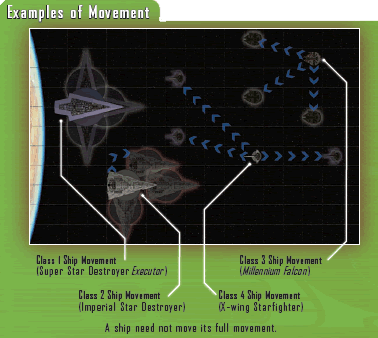 A: No and no. A Class 1 or Class 2 ship can turn only if it moves 1 square immediately afterward. Essentially, the turn is the first part of the action of movement, so it can't be separated from moving or be changed to a different order. Thus, no turning in place is allowed, and no turns can occur after movement. Q: According to the rules, when a Class 1 or Class 2 ship displaces an enemy fighter, that fighter must be moved the shortest possible distance. What happens if the enemy fighter is pinned in at the edge of the map, and the shortest possible distance would be to go off the map? Would the fighter move off? A: No. You always displace the shortest possible distance, but the fighter must move into a legal square. If this situation occurs, look for the closest legal square (in other words, it must be on the map, it can't be occupied by another ship, and so on) and displace the fighter to that square. Q:When a fighter moves into a square adjacent to an enemy fighter, it has to stop. Can it move in the next round, or is it unable to move as long as the enemy fighter remains adjacent? A: The rule is that a fighter has to stop moving the moment it moves into a square adjacent to an enemy fighter. Nothing restricts it from moving out of such a square when beginning the round adjacent to an enemy fighter. Of course, if the fighter's first square of movement puts it adjacent to an enemy fighter again (even the same enemy fighter), it has to stop again. But it can always move at least 1 square before that happens. Q: Let's say that you have a Class 3 or larger starship adjacent to an enemy fighter. You move one of your fighters through that larger starship's space, but the square you move through is adjacent to the enemy fighter. The rules say you have to stop, but you can't stop in the same square occupied by another ship. What happens? Does your fighter get "displaced," as when a Class 1 or Class 2 enemy ship enters a square? A: Actually, this move would be illegal. Before entering a square, you must determine if doing so would break any rules. In this case, entering that square would require you to stop, but you can't stop inside another ship's square. Therefore, you can't enter that square in the first place. About the AuthorGary M. Sarli is a freelance designer, developer, and editor whose credits include the Saga Edition rulebook and Ultimate Adversaries (for the Star Wars Roleplaying Game) and Power of Faerûn and Fiendish Codex II: Tyrants of the Nine Hells (for Dungeons & Dragons). He also moderates on the Wizards.COMmunity message boards as WizO the Hutt, cheerfully feeding Code of Conduct violators to the Sarlacc. Gary recently opened GMSarli Games, an online retailer specializing in making non-random miniatures packs designed for the Star Wars Roleplaying Game.
| ||||


 A: No, it's not a mistake. A Jedi, Sith, or any other lightsaber-wielding character can use a form -- even be considered a master of that form to in-universe observers -- without having the associated lightsaber form talent. After all, being a "master of a form" is a label that's completely subjective, in-universe, and not based on game mechanics. Someone is a "master" if others perceive it to be so. Certainly, someone who takes a lightsaber form talent is probably recognized as a master by others, but that doesn't mean that only someone with a lightsaber form talent can be considered a master.
 Alternatively, a character with a close connection to the Jedi, such as an Antarian Ranger, might take levels in the Jedi class, despite being non-Force-sensitive. Such a character might find some Jedi Guardian or Jedi Consular techniques rubbing off on him after working together for so long.