| Home |
|
|||
 | ||||
Tips & Tactics Vol. 3, No. 3Synergy | ||||
|
Welcome back to Tips and Tactics, the column of Star Wars gaming advice. (This is actually the third edition of Tips and Tactics. The first edition covered the previous version of the Star Wars Roleplaying Game. The second edition focused more on the Star Wars Miniatures Game, and you can search our full site archives for some of these columns.) This new incarnation of Tips and Tactics will cover both the Star Wars Roleplaying Game Saga Edition and the Star Wars Miniatures Game. Approximately every two weeks, Tips and Tactics will give hints, ideas, advice, or alternative rule ideas. Anything from covering the basics for new players to sneaky strategies for experienced participants is fair game, and from time to time, we'll even discuss how to combine the two games. In this installment, we'll look at how to use synergy to build a squad of miniatures or a group of heroes that's stronger than the sum of its parts.
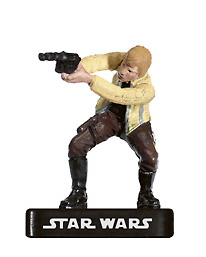
Squad Synergy in the Minis GameThe cost of units in the Star Wars Miniatures Game is based on an efficient use of their abilities. The possibility of other characters giving them good synergy is included in these costs, which means that if you aren't building squads to take advantage of such options, you're paying for possibilities you aren't using. Some synergy is obvious, such as the Rebel Captain's commander effect giving Twin Attack to Rebel Troopers. Other options are more subtle, but all the more effective for their complexity. For an example of good synergy, let's start with Luke Skywalker, Hero of Yavin. This character costs 35 points, making him a major investment for a 100- or 150-point squad, but he can be worth every point. The character is already impressive, with numerous abilities that you can build from. Most important, it has the following abilities:
These combine to make a character who deals good damage, can move in and out of cover quickly, and is able to avoid damage from ranged attacks. That's a good start, but we can improve on it. The fact that the character has Force points leads to some interesting options. You can team Obi-Wan Kenobi, Jedi Spirit with Luke to give him Force Renewal 1 and Mettle. Now Luke is much less likely to run out of Lightsaber Deflect options, and if not threatened, he can spend Force points freely to make an attack more effective. Not bad for a mere 8 more points. Since Luke is more likely to score a critical hit than most characters, and since he gains an extra attack when he does, it's worth trying to give him more opportunities to make that happen. Adding Princess Leia to the squad makes use of her commander effect, choosing one Rebel follower to make an immediate attack at +4 to hit and +10 damage each round. If Luke uses his Double Attack and gains an extra attack from Leia, he gets to use Twin Attack with each of those attacks. Thus, he's making six attacks per round, and in each case, he has a better-than-average chance of scoring a critical and an extra attack.
After you've assembled a core of characters with effects that play off one another, building the rest of your squad is largely a matter of how many points you have left, though you should continue to look for potential synergy. It's never a bad idea to protect your core characters in some way, often with characters with the Bodyguard special ability. A Twi'lek Bodyguard can be added to a squad of any faction, as can a Mistryl Shadow Guard (if you have considerably more points). Finding synergy between characters is an ongoing process and includes discoveries made during play, often when an opponent unleashes something new on you. Consider keeping a notebook of ideas and tactics you observe during games, even those in which you're not playing. Since such tactics are generally built around special abilities possessed by more than one character, you might find that you can adapt other squads' synergies to work with your own figures. As you observe what does and doesn't work well, you'll start seeing possibilities as soon as you pick up new characters, giving you new options for cohesive, synergy-filled squads. Group Synergy in the Roleplaying GameThe same ideas can be applied to heroes in the Star Wars Roleplaying Game Saga Edition. While any group of four characters can be a successful team, giving them different classes and roles can produce groups that are more effective and more flexible. Don't worry if that means the only hero is a Force-using Jedi. The other heroes can add more to the group's overall success exactly because they aren't lightsaber-toting masters of melee.  For example, a Jedi might have the same attack bonus and hit points as a soldier, but that doesn't mean a soldier has nothing to offer. In addition to being much better in heavy armor (and the only character for whom armor can still be an excellent choice at mid or high level), a soldier has numerous options that can aid other characters in combat. The Commando talent tree has Battle Analysis, Cover Fire, Draw Fire, and Harm's Way, all of which can make even a Jedi more effective in group combat. Combined with talents that allow a soldier to take amazing amounts of damage and deal similarly heavy wounds at range, the result is an ally who can make it through any combat and harm foes before they get too close. A noble, too, can help to improve the performance of other characters. The Inspiration and Coordinate talent trees are full of abilities that help Jedi and soldiers be even more dangerous in combat, but those talents have other uses as well. The ability to increase skill checks can mean the difference between dying in a trash compactor and escaping an Imperial space station in a run-down freighter. A noble can also restore health to allies, allowing them to keep doing what they're good at in longer fights. Finally, while a noble might not be a master of hand-to-hand combat, her ability to intimidate foes and move them down the condition track can overcome opponents who are physically intimidating but mentally average. Scoundrels and scouts can hold their own in a fight, but their real benefit to a group is often outside of combat. Part of the fun of a roleplaying game is facing different situations and working as a team to overcome them. A group that lacks a scoundrel or a scout is at a serious disadvantage when flying through an asteroid field, tracking down an escaped foe, negotiating a deal with a Hutt, sneaking up on an encampment, sneaking through the halls of an enemy base, or fixing a broken speeder. If you're playing either of these classes, ask the other players what skills their characters are trained in, and take at least a few skills that aren't already covered. Chances are that no one else is trained in Stealth or Survival, and perhaps not Acrobatics, Climb, Jump, or Mechanics. Being good in areas where other characters are not is the heart of group synergy, and the scoundrel and scout are perfect choices for that. Other important choices have little or nothing to do with class. For example, it's useful to have a trained pilot or someone who can use medpacs effectively. Having a mix of melee weapons and ranged weapons often pays off in combat. Similarly, a group that owns a wide variety of equipment is more versatile than one that has six fire extinguishers but no electrobinoculars. Talk to other players during character creation and as their heroes gain levels, and you'll find ways to take advantage of their strengths and cover their weaknesses. About the AuthorOwen Kirker Clifford Stephens was born in 1970 in Norman, Oklahoma. He was introduced to gaming by his uncle in 1978 and was instantly hooked. He later enrolled in creative writing courses taught by Forgotten Realms novel author Mel Odom. In 1997, he attended a TSR Writer's Workshop, and later that year, his first professional work saw the light of day: an article on elven names in issue 251 of Dragon magazine. In 2000, Owen moved to the Seattle area with his wife and three cats after accepting a job as a Game Designer at Wizards of the Coast. There, he worked on numerous Star Wars Roleplaying Game products and the Wheel of Time Roleplaying Game. Fourteen months later, he returned to Oklahoma and picked up his freelance career, writing for numerous companies, including Green Ronin, Paizo, White Wolf, and Steve Jackson Games. Owen co-authored the Star Wars Roleplaying Game Saga Edition Core Rulebook and has contributed to numerous licensed RPG products, including The Wheel of Time, EverQuest, Black Company, and Thieves' World. | ||||